'/%3E%3C/svg%3E)
'/%3E%3Cpath%20fill='%23b2b2b2'%20d='M241%20382q0%2016%2017%2026%2017%2011%2042%2011t42-11q16-11%2017-26V269H241'/%3E%3Cpath%20fill='%239f7e00'%20d='M241%20379q0%2014%208%2023%209%209%2021%209%2014%200%2021-9%209-9%209-23V269h-59'/%3E%3Cpath%20d='M241%20339v-70h59v110q0%2014-9%2023l-6%205v-68h-15v72q-8%200-14-4v-68zm59%2040c0%2022%2015%2032%2029%2032%2021%200%2030-18%2030-32v-40h-59'/%3E%3Cpath%20fill='%239f7e00'%20d='M266%20277v5h2v12h-3v-5h2v-5h-9v5h2v5h-4v9h3v18h-5v10h34v-10h-5v-18h3v-9h-4v-5h2v-5h-9v5h2v5h-3v-12h2v-5zm42%20101q0%2010%206%2017%206%206%2015%207%2010-1%2016-7%206-7%206-17v-29h-43'/%3E%3Ccircle%20fill='%230044ad'%20cx='329.5'%20cy='372'%20r='6'/%3E%3Cellipse%20fill='%230044ad'%20cx='300'%20cy='340'%20rx='16'%20ry='21'/%3E%3C/svg%3E)

Study reveals digital risk in childhood, widening digital divide since the pandemic, families and teachers concerned.
Children access digital devices from the age of 5
● A pioneering study reveals how elementary school children face digital risks with little family and educational preparation.
● Families express concern about sexist content, online threats, and digital addictions, while demanding urgent training.
● Teachers point out that the pandemic has worsened the digital divide and warn about the uncontrolled use of devices in school settings.
What do children see, experience, and suffer when they browse the internet?
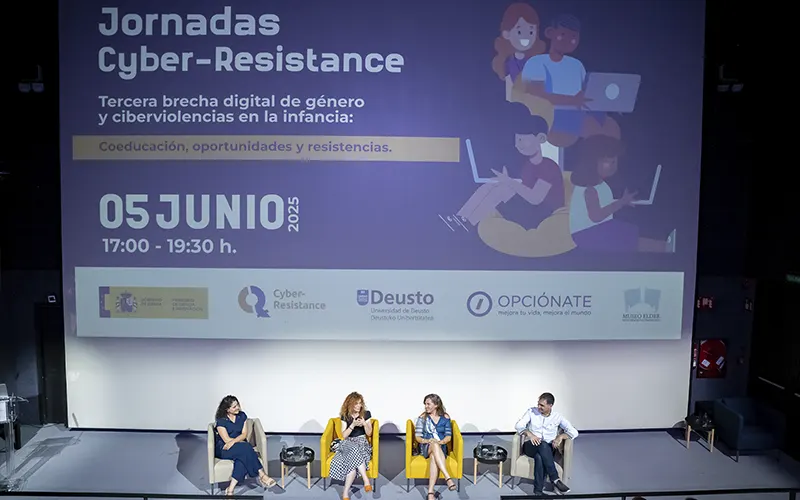
This is the question that has guided Cyber-Resistance, a pioneering research project promoted by the University of Deusto and the Opciónate association of Gran Canaria. The project is part of the RETOS 2022 national call and is funded by the Ministry of Science, Innovation, and Universities of the Government of Spain. Estíbaliz Linares Bahillo, professor and researcher at the University of Deusto, and Ana Lidia Fernández Layos, researcher at the University of Deusto and Director of Opciónate, are responsible for this study, which was presented today at the Museo Élder in the capital of Gran Canaria.
The report, entitled “Facing the Third Digital Gender Divide and Cyberviolence in Childhood: Coeducation, Opportunities, and Resistance,” focuses on the 6-12 age group and highlights how early digitalization has exposed girls and boys to sexist content, cyberbullying, stereotypes, and power dynamics that perpetuate inequality. The study, conducted in primary schools in Gran Canaria and the Basque Country, gathered the opinions of 460 participants, including students, families, and teachers.
The objective: to understand how children experience the third digital gender divide and cyberviolence, which is increasingly prevalent from an early age.
“The results are clear and worrying. Girls are exposed to hypersexualized content, gender stereotypes, and sexist discourse through social media, music, and video games. The lack of adequate affective-sexual education leaves many minors without the tools to identify or protect themselves from this content. Boys, for their part, are exposed to violent and sexist models of masculinity from a very young age,” says researcher Fernández Layos. “Families, especially mothers, admit to feeling overwhelmed by the speed of the digital environment. Eighty percent apply severe restrictions on device use, but without clear strategies or technical training. Fear, contradiction, and misinformation are common feelings in homes. Parents are often more permissive and introduce devices and video games into their homes and share online entertainment with their children.”
Teachers also warn that the overuse of technology following the pandemic has deteriorated students’ attention, behavior, and emotional health. Schools have implemented devices without adequate training or a clear pedagogical model, generating conflicts even during school hours. Given this situation, the report calls for immediate action. These include mandatory training in digital skills for families and teachers, awareness campaigns with a feminist and inclusive approach, and public policies that regulate the use of technology in educational contexts.
Cyber-Resistance will continue to develop until 2026. Its goal is to transform alarm into action, proposing strategies that protect children and promote a fairer, safer, and more equitable digital environment in schools and at home. Conclusions: The digital world is a reflection of the physical world and therefore has a patriarchal structure that perpetuates differences and discrimination between the sexes and sexist violence.
1. There is a digital knowledge and skills gap throughout the educational community, manifested in training gaps and a lack of clarity and consensus.
2. Minors are aware of most of the dangers of both excessive use and access to content and video games inappropriate for their ages, but they do not know or use the necessary tools to protect themselves.
3. To make progress in the protection of minors and the creation of an equal and safe digital environment, a social pact is necessary.
4. Another challenge is to guarantee the responsibility of companies that manage the online world in the protection of minors, a social environment of zero tolerance for all forms of violence and sexism, and the guarantee of good treatment and protection in their virtual and in-person relationships.
5. To achieve this, it is essential to commit to a digital ethic based on care, equality, and justice, centered on the responsibility of the adult world, towards the protection of children, as well as the empowerment of girls and boys with critical thinking and emotional and social intelligence.
The event was streamed and can be viewed at the following link starting at 5:30:
Cyber-Resistance Conference