


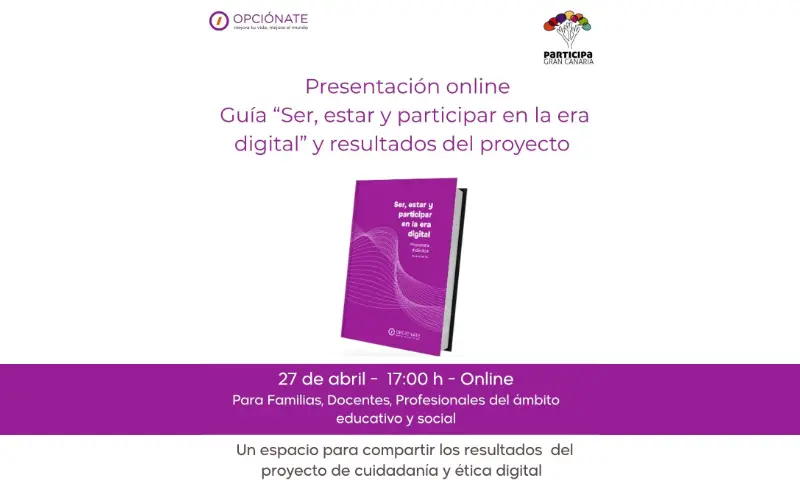
On April 27, the organization held an online event to share the main outcomes of the “Digital Care Citizenship and Ethics” project and to launch the guide “Being, Belonging and Participating in the Digital Age”, a resource designed to promote more conscious, critical, ethical, and respectful participation in digital environments.
The event brought together families, teachers, and professionals from the educational and social sectors in a space for dialogue and exchange, where participants explored the project’s key learnings, practical tools, and experiences developed in collaboration with schools, educators, students, and families.
A project to strengthen digital citizenship
This initiative aims to promote ethical, critical, and participatory digital citizenship, incorporating a care-based approach to the use of technology through collaborative work with schools in Gran Canaria.
Between January and April, a total of 22 training sessions were carried out across 4 educational centres, involving 35 teachers and around 200 students. In addition, between 75 and 90 students have taken part in 7 further sessions alongside their teachers and will continue working on these topics until the end of the academic year.
These sessions addressed key topics such as digital critical thinking, care in online environments, digital rights and responsibilities, and social participation.
The project has also reached over 10,000 people through dissemination activities, social media, and awareness-raising initiatives targeting the educational community.
Conclusions and proposals for the educational and social sectors
The session also provided an opportunity to identify key recommendations for further integrating digital education into different contexts.
Among the main conclusions was the need to promote specific training for teaching staff, integrating it into school planning from the beginning of the academic year. It was also highlighted that providing materials in advance can support better planning and contribute to team cohesion and coordination.
In the field of vocational education, participants pointed to concerns regarding students’ problematic use of mobile devices, as well as opportunities to integrate these topics into technical education through innovative methodologies such as service-learning or challenge-based learning.
Additionally, the need to extend this type of training to juvenile justice settings and youth centres was identified, targeting both professionals and young people, and promoting “train-the-trainer” programmes to ensure continuity and adaptability.
Commitment to responsible digital citizenship
This activity, funded by the Citizen Participation Unit of the Cabildo de Gran Canaria, reinforces Opciónate’s commitment to promoting ethical, participatory, and inclusive digital citizenship.
We would like to especially thank the participating schools, teachers, and students, whose engagement has been essential to the success of the project.
We will soon share some of the audiovisual and creative work produced as part of this initiative.