Client: Island Council of Lanzarote and La Graciosa, Comprehensive Women’s Support Service (SIAM)
Implementation date: November 12-13, 2026
Type of service: Training, Research
A professional forum on emerging forms of Gender-Based Violence
On November 12 and 13, 2026, Lanzarote hosted the conference “Gender-Based Violence and New Spaces of Violence”, a two-day event for professionals in social services, education, the legal system and healthcare. It was organized by the Comprehensive Women’s Support Service (SIAM), part of the Department of Social Welfare and Inclusion of the Cabildo of Lanzarote and La Graciosa, in collaboration with the Canary Islands Institute for Equality (ICI). It was funded through the State Pact against Gender-Based Violence, with institutional support from the Ministry of Equality, the Government of the Canary Islands and Akacenter.
The program brought together perspectives from psychology, forensic medicine, law, sociology and communication studies. On the first day, after the opening session, Beatriz Ortiz González spoke on myths, biases and misconceptions about women survivors; Miguel Lorente Acosta addressed the question “Why do men abuse?”; and Noelia Rebón examined the legal evolution of vicarious violence and the new challenges for protection. The second day focused on digital environments and ended with a panel discussion.
Opciónate’s presentation: When the phone becomes a tool of control
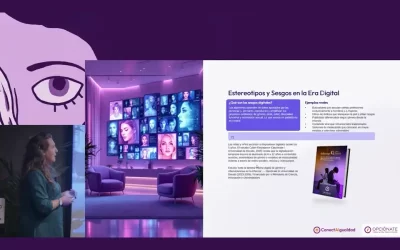
Opciónate took part through its Director, Ana Lidia Fernández Layoz, a senior specialist in gender equality, digital violence and international project evaluation. On November 13 she delivered the presentation “When the Cell Phone Becomes a Tool of Control”. Its starting point was that digital control is also a form of gender-based violence within couples: because the phone sits at the center of daily life, intimacy and identity, it can become an infrastructure for surveillance, pressure and isolation.
The presentation covered digital micro-sexisms and the myths of romantic love that normalize control, the “ten faces” of digital control (passwords, geolocation, messaging, social media, images, money and contacts), signs of spyware, and the escalation from a request to a threat. It also addressed artificial intelligence and deepfakes, control that persists after a relationship ends, digital consent, and the difference between mutual control and gender-based violence, drawing on Opciónate’s research in Gran Canaria. It closed with the responsibility of bystanders, guidance for professional response and help resources, under the message “caring is not monitoring”.
Viral misogyny and online recruitment
Professor Asunción Bernárdez Rodal, Chair of Journalism at the Complutense University of Madrid, analyzed how misogyny spreads online through the manosphere and anti-feminist narratives, with particular attention to young people. She explained why this content goes viral, “from fear to anger, and from anger to the click”, and how algorithms register the reaction rather than the intention. She illustrated this with an excerpt from the documentary short “La mécanique des fluids” (Gala Hernández, 2022), which follows the online trail of a young incel in internet forums.
Esther Torrado-Palomino, a doctor in Sociology and tenured professor at the University of La Laguna, then showed how women and girls are recruited into prostitution through social networks. She traced the evolution of social media and compared past recruitment methods (personal contacts, intermediaries, false job promises, exploitation in brothels) with current ones (fake profiles and impersonation, grooming and emotional manipulation, fake job offers, blackmail and sextortion, exploitation in private homes and digital environments), pointing to three key changes: the channel, the reach and the control.
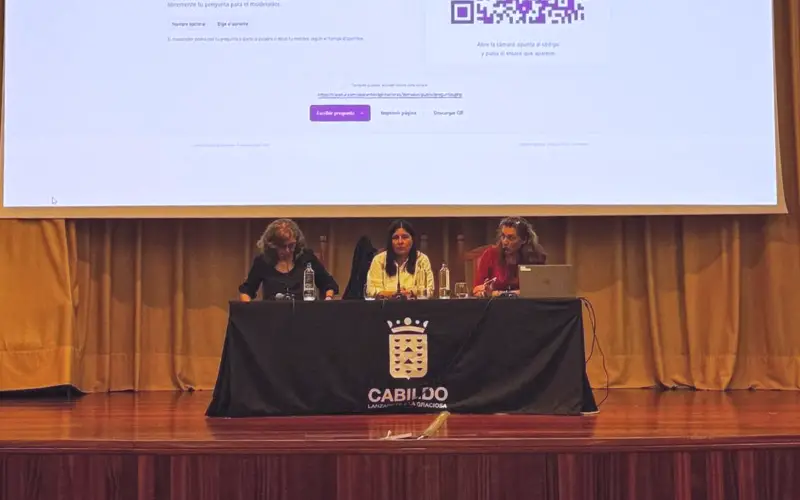
The three speakers of that day then joined the panel discussion that closed the program.
Reinforcing the commitment to violence-free environments
Opciónate’s participation, through both its presentation and the panel discussion, brought specialized knowledge on digital violence to the event and underscored the need to build this perspective into the prevention, identification and support of gender-based violence. Through this collaboration, Opciónate reaffirms its commitment to gender equality, the prevention of technology-facilitated gender-based violence, and the promotion of safe, inclusive and violence-free digital environments through a human rights-based approach.