


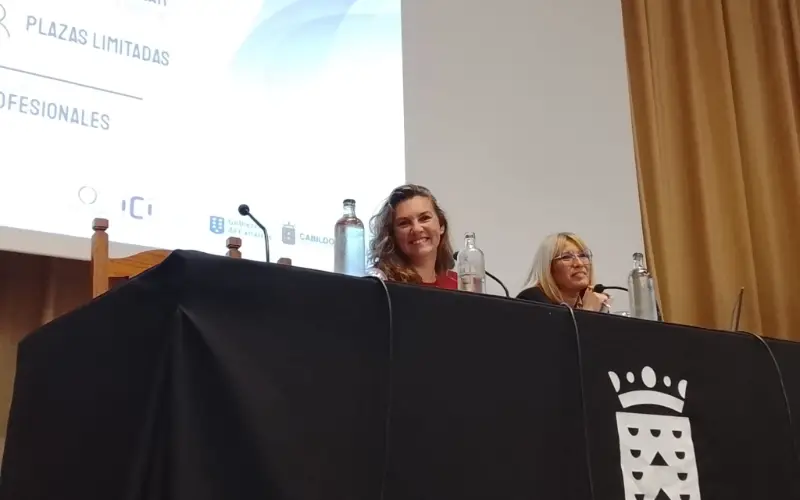
Opciónate’s Director, Ana Lidia Fernández Layoz, delivered a presentation on how the phone becomes a tool of control at the Lanzarote Conference and joined the panel discussion that closed the program on November 13.
On November 12 and 13, 2026, the Assembly Hall of the Cabildo of Lanzarote and La Graciosa hosted the conference “Gender-Based Violence and New Spaces of Violence”, a professional event aimed at the social services, education, legal and healthcare sectors. It was organized by the Comprehensive Women’s Support Service (SIAM), part of the Department of Social Welfare and Inclusion of the Cabildo, in collaboration with the Canary Islands Institute for Equality (ICI), and funded through the State Pact against Gender-Based Violence, with institutional support from the Ministry of Equality, the Government of the Canary Islands and Akacenter.
A program on how forms of violence are evolving
After an opening session with representatives of the Cabildo, the ICI and the central government’s delegation in Lanzarote, the first day covered the foundations. Beatriz Ortiz González, a psychologist specializing in work with survivors, addressed myths, biases and misconceptions about women who experience gender-based violence. Miguel Lorente Acosta, a forensic physician and former Government Delegate against Gender-Based Violence, asked “Why do men abuse?”. Lawyer and doctor of law Noelia Rebón examined the legal evolution of vicarious violence and the new challenges for protection.
The second day turned to digital spaces, opening with Opciónate’s presentation.
“When the Cell Phone Becomes a Tool of Control”
Ana Lidia Fernández Layoz, a senior specialist in gender equality, digital violence and international project evaluation, argued that digital control is also gender-based violence within couples. The phone is part of daily life, intimacy, identity and autonomy, which is why it can become an instrument of surveillance, pressure and isolation.
The presentation showed how control enters relationships through digital micro-sexisms and myths of romantic love (“if you love me, tell me where you are”), and walked through the “ten faces” of digital control: demanding passwords, tracking location, reading or deleting messages, monitoring social media, demanding or removing photos, supervising spending, or deciding who someone can talk to. It explained how these behaviors can escalate from a request to an obligation, isolation and threats, and pointed to technical signs of spyware.
She also addressed the use of artificial intelligence to fabricate or manipulate images (deepfakes), control that persists after a relationship ends through shared accounts, open sessions and geolocation, and digital consent, which must be explicit, reversible and contextual. She stressed a key distinction: the fact that both partners engage in controlling behavior does not necessarily mean power is symmetrical, nor does it rule out gender-based violence.
The talk drew on Opciónate’s research in Gran Canaria with 331 women: 36.9% had personally experienced at least one of the situations of technology-facilitated violence analyzed within a couple or ex-couple context, and 27.5% had a partner or ex-partner take their phone to monitor calls, messages or contacts. For Lanzarote, she cited the 1,311 emergency and urgent calls about gender-based violence recorded in ten months of 2025, and asked how many women are being monitored through their phones without appearing in statistics as victims of digital violence.
The presentation ended with the responsibility of bystanders (not sharing intimate images, not justifying control as love, supporting without exposing the survivor to greater risk) and guidance for professionals: listen and believe, assess risk, avoid hasty technological changes when surveillance may be present, design an individual digital safety plan, and refer to specialized services. The closing message was clear: “control is not love, it is violence”.
Viral misogyny and online recruitment
Asunción Bernárdez Rodal, Chair of Journalism at the Complutense University of Madrid, then spoke on “Misogyny goes viral: the manosphere, anti-feminisms and young people”. She explained why such content spreads: fear looks for someone to blame and turns into anger, anger is fast, binary and predictable, and the algorithm registers the reaction, not the intention, and learns what makes you angry. She illustrated the point with an excerpt from “La mécanique des fluids” (Gala Hernández, 2022), winner of the César Award for best documentary short, which follows the online trail of a young incel through loneliness, isolation and a vulnerability turned into resentment.
Esther Torrado-Palomino, a doctor in Sociology and tenured professor at the University of La Laguna, closed the series of presentations with “From social networks to exploitation: women and girls recruited into prostitution”. She traced the history of social media and compared past recruitment methods (personal contacts, intermediaries and pimps, false job promises, control through violence, exploitation in brothels) with today’s (fake profiles and impersonation, grooming and emotional manipulation, fake job offers, blackmail and sextortion, exploitation in private homes and digital environments). She summarized the changes along three lines: the channel, the reach, which has moved from local networks to networks operating across countries, and the control, which combines threats and dependency with digital control and extortion.
The three speakers of that day then took part in the panel discussion that closed the program, an opportunity to exchange experiences and reflections with the audience.
Our commitment
Opciónate would like to thank SIAM and the Cabildo of Lanzarote and La Graciosa for the invitation to contribute to a conference that made space for sharing knowledge and reflecting on current challenges in preventing and addressing gender-based violence. This participation reinforces Opciónate’s commitment to gender equality, the prevention of technology-facilitated gender-based violence, and the promotion of safe digital environments grounded in human rights.